



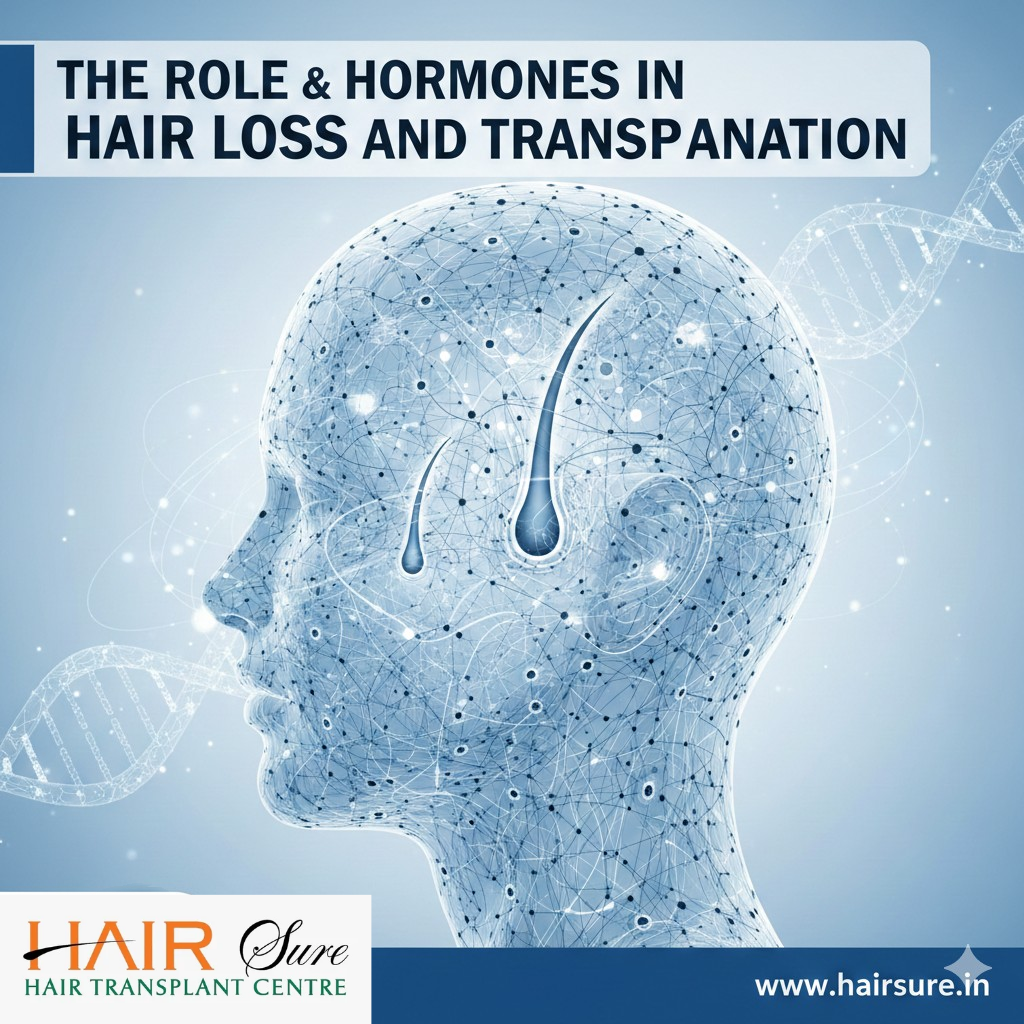
The Hormonal Hair Cycle: A Brief Overview
Our hair follicles go through a continuous cycle of growth (anagen), regression (catagen), and rest (telogen). This cycle is influenced by a multitude of factors, with hormones being a significant player.
Androgens – The Primary Culprits in Pattern Hair Loss:
When we talk about hormones and hair loss, androgens are almost always the centre of the discussion. These male sex hormones, present in both men and women, include testosterone and dihydrotestosterone (DHT).
Testosterone: While essential for various bodily functions, testosterone itself isn’t the direct cause of pattern hair loss.
Dihydrotestosterone (DHT): This potent androgen is a derivative of testosterone, converted by an enzyme called 5-alpha-reductase. DHT is the primary hormone responsible for shrinking hair follicles in genetically predisposed individuals, leading to shorter, finer hair over time (miniaturization) and eventually complete cessation of growth.
How DHT Affects Hair Follicles
For those with a genetic sensitivity, DHT binds to receptors in the hair follicles on the scalp (primarily the front, top, and crown). This binding triggers a process that:
Miniaturises the follicles: The growth phase (anagen) shortens, and the resting phase (telogen) lengthens.
Produces finer, weaker hair: Each new hair strand becomes progressively thinner and weaker.
Eventually leads to dormant follicles: Over time, the follicles shrink so much that they stop producing visible hair altogether.
Interestingly, hair follicles on the back and sides of the scalp are generally resistant to the effects of DHT. This is a critical factor in the success of hair transplantation.
Hormonal Imbalances Beyond DHT
While DHT is the most common culprit, other hormonal imbalances can also contribute to hair loss:
Thyroid Hormones: Both an overactive (hyperthyroidism) and an underactive (hypothyroidism) thyroid can disrupt the hair growth cycle, leading to diffuse hair shedding.
Estrogen and Progesterone (in women): Fluctuations in these female hormones, such as during pregnancy, childbirth, menopause, or due to conditions like PCOS (Polycystic Ovary Syndrome), can cause temporary or chronic hair thinning. In PCOS, elevated androgen levels are often a contributing factor.
Insulin Resistance: Some research suggests a link between insulin resistance and hair loss, particularly in women.
Hair Transplantation and Hormones: A Smart Solution
The good news for individuals experiencing pattern hair loss is that hair transplantation offers a highly effective and long-lasting solution. This is precisely because of the differential sensitivity of hair follicles to DHT.
The Principle:
During a hair transplant, healthy, DHT-resistant hair follicles are extracted from the donor area (typically the back or sides of the scalp)
Why choose HAIRSURE?
At HairSure, we are dedicated to a policy of offering patients unmatched services. At HairSure Advanced Hair Transplant Clinic, all of your hair-related worries can be expertly resolved, and you can rest assured that your smile won’t flinch again. Enter HairSure and exit with the desired appearance.
HairSure can assist in determining the precise reason for hair loss and offer suitable treatment solutions that are suited to the requirements of the individual. Always consult a medical expert when you have questions about your health. Always consult a medical expert when you have questions about your health.
We at HairSure, are committed to providing matchless services to all our patients. All your concerns regarding hair problems can be flawlessly sorted at HairSure Advanced Hair Transplant Clinic, guaranteeing that you will be left with smiles that won’t fall again. Walk into HairSure and walk back with the look that you desire. Call 040 42020202 / 9494020202 or email us at hairsure123@gmail.com to book your consultation. Visit our website, Hair Transplant Clinic, to know more.